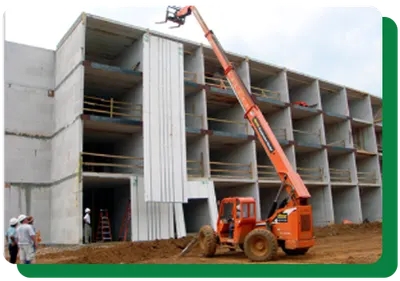
St. John’s, Antigua
Jumby Bay Island Corp. Headquarters
Challenge
Completely open floor plan w/no interior walls
Reduce the construction time and the amount of concrete used which is expensive and time consuming. Building must withstand the highest of hurricane wind criteria. Achieve energy efficiency, significantly reducing the cost of HVAC equipment and operating costs.
Solution
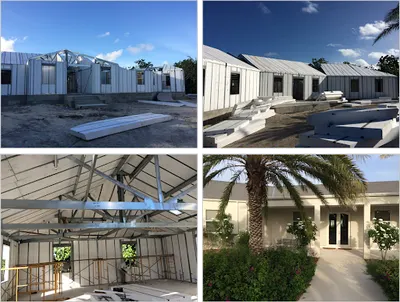
Used SHIELD™ 6” R-24 walls & 8” R-32 roof
Custom designed and engineered steel trusses to clear span entire building.
Result
Exterior building shell was completed in 2 weeks instead of typically 4 months.
Significantly reduced HVAC equipment and operating costs.
Survived Hurricane Irma a powerful CAT5 without damage to the building.
Why this approach fit
Commentary from our editorial team. The challenge, solution and result above are the project record as reported by Guardian Structural.
A completely open floor plan with no interior walls means every load has to travel to the perimeter. That is why this project pairs a panel envelope with custom steel trusses clear-spanning the whole building: there is nothing in the middle to bear on, so the roof structure has to reach across in one go.
The panel roof then sits on that structure as a continuous insulated deck. Eight-inch panels at R-32 over the roof and six-inch panels at R-24 on the walls give an envelope with no interior bearing points interrupting it, which is what an open plan requires and what a conventional framed roof over the same span struggles to deliver without dropping columns into the space.
The schedule figure Guardian reports is the most dramatic on this site, an exterior shell in two weeks against a typical four months. Read it as their comparison against conventional island construction rather than a controlled study, but the direction is consistent with every other project here: the gain comes from replacing a sequence of site operations with a single erection operation.
The building shares the Antigua design brief with State Insurance Corp nearby. Reduce imported concrete, meet the highest hurricane wind criteria, and cut the cooling load enough that the mechanical equipment gets smaller as well as cheaper to run. Both buildings came through Hurricane Irma in 2017.